


Views: 0 Author: Site Editor Publish Time: 2026-07-23 Origin: Site


In high-pressure fluid and gas transport, the structural integrity of a Reinforced Thermoplastic Pipe (RTP) relies almost entirely on its reinforcement layer. A fractional deviation in tape winding tension or bonding temperature can lead to localized delamination, compromising burst pressure ratings and leading to catastrophic field failures. These minute deviations often go unnoticed during standard visual inspections. However, they drastically weaken the pipe under cyclic loading conditions. The resulting leaks or ruptures trigger severe safety hazards and expensive environmental cleanups.
For procurement engineers and project managers, understanding how a top-tier rtp pipe manufacturer controls the winding process is critical for mitigating operational risk, ensuring compliance, and auditing supplier capabilities. We will explore the precise engineering mechanics behind dynamic tension control, multi-layer synchronization, and rigorous thermal consolidation. You will learn how to audit factory testing methods and verify safety margins. These insights empower you to confidently select suppliers and ensure long-term reliability across your pipeline infrastructure.
Tension determines performance: Precise, automated tension control prevents tape wrinkling and resin starvation, which are the primary causes of premature RTP failure.
Material dictates process: The control parameters vary significantly between unidirectional (UD) glass fiber tapes, aramid, and carbon steel strips.
Thermal bonding is critical: Real-time temperature monitoring ensures complete consolidation between the thermoplastic matrix and the reinforcement layers without degrading the polymer.
Auditing matters: Evaluating an RTP supplier requires looking beyond spec sheets to their inline non-destructive testing (NDT) and automated QA infrastructure.
The winding process serves as the central load-bearing component of any reinforced pipe. You rely on these composite structures to handle extreme internal pressures over decades of continuous operation. Poor winding execution directly translates to lowered burst pressure. It drastically reduces the mean time between failures (MTBF). If the structural layers fail prematurely, entire pipeline networks face sudden and dangerous shutdowns. These disruptions stall production and incur massive remediation costs.
Uneven tape distribution causes dangerous localized stress concentrations across the pipeline body. When a pipe experiences fluid pressure, hoop stress pushes outward against the internal walls. If the reinforcement tape lacks uniform tension, this outward stress creates severe structural imbalances. The weaker sections absorb disproportionate force. This imbalance causes microscopic cracking in the polymer matrix. These micro-cracks eventually propagate, rupturing the external protective jacket.
A reliable winding process guarantees uniform stress distribution across every meter of the spool. You gain dimensional stability even under fluctuating environmental temperature cycles. Manufacturers must deliver verifiable compliance alongside these physical properties. Engineers rely on stringent international standards like API 15S or ISO 18292 to qualify these pipes for deployment. Meeting these strict criteria ensures long-term safety margins. It proves the manufacturer can consistently replicate structural perfection.
Different operational environments demand completely different reinforcement strategies. The winding machinery must adapt to the specific material properties of the tape. Quality control tolerances shift significantly based on the chosen fiber type. You cannot use the same tensioning profiles for rigid metal as you do for flexible synthetic fibers.
These tapes are widely used by global glass fiber RTP manufacturers for a balance of cost, corrosion resistance, and tensile strength. They embed aligned glass fibers directly into a thermoplastic matrix. This creates a strong, lightweight composite material.
They provide excellent resistance against harsh chemical environments.
They maintain a lower physical weight compared to metallic alternatives.
They offer a highly competitive cost-to-performance ratio for onshore projects.
However, this material requires strict resin-impregnation quality checks prior to the winding stage. Dry spots in the tape lead to immediate bonding failures. These dry fibers fail to fuse during thermal consolidation, creating hidden voids inside the pipe wall.
Steel offers exceptionally high pressure ratings for deepwater operations or high-demand onshore lines. Yet, it introduces distinct complexities regarding spool weight and overlap precision. Winding metallic strips requires immense mechanical force. You must prevent metal-to-polymer debonding over the pipeline's lifecycle.
Engineers face significant challenges matching the flexibility of plastic liners with rigid steel layers. Specialized adhesion promoters prevent the steel from slicing into the inner liner. Precise tensioning keeps the heavy metal strips perfectly aligned. Any overlap deviation creates a sharp edge. This edge can puncture the surrounding thermoplastic jacket during field bending.
These synthetic fibers deliver an incredible strength-to-weight ratio. They excel in demanding offshore environments or extreme-terrain applications. You can transport them easily due to their exceptionally low weight. Operators frequently deploy aramid-reinforced pipes in remote locations where heavy lifting equipment cannot operate.
However, they require ultra-sensitive tension control on the production line. Sudden tension spikes will cause the fragile fibers to snap instantly. Operators must maintain gentle, consistent pulling forces. Even minor friction from the guiding rollers can damage the aramid filaments before they reach the pipe liner.
Table: Reinforcement Material Characteristics
Material Type | Primary Advantage | Winding Challenge | Typical Application |
|---|---|---|---|
UD Glass Fiber | Optimal cost and corrosion resistance | Requires perfect resin impregnation | Standard onshore flowlines |
Carbon Steel | Maximum burst pressure capacity | Heavy weight; adhesion difficulties | High-pressure gathering lines |
Aramid / Kevlar | Superior strength-to-weight ratio | Highly sensitive to tension spikes | Offshore and extreme terrains |
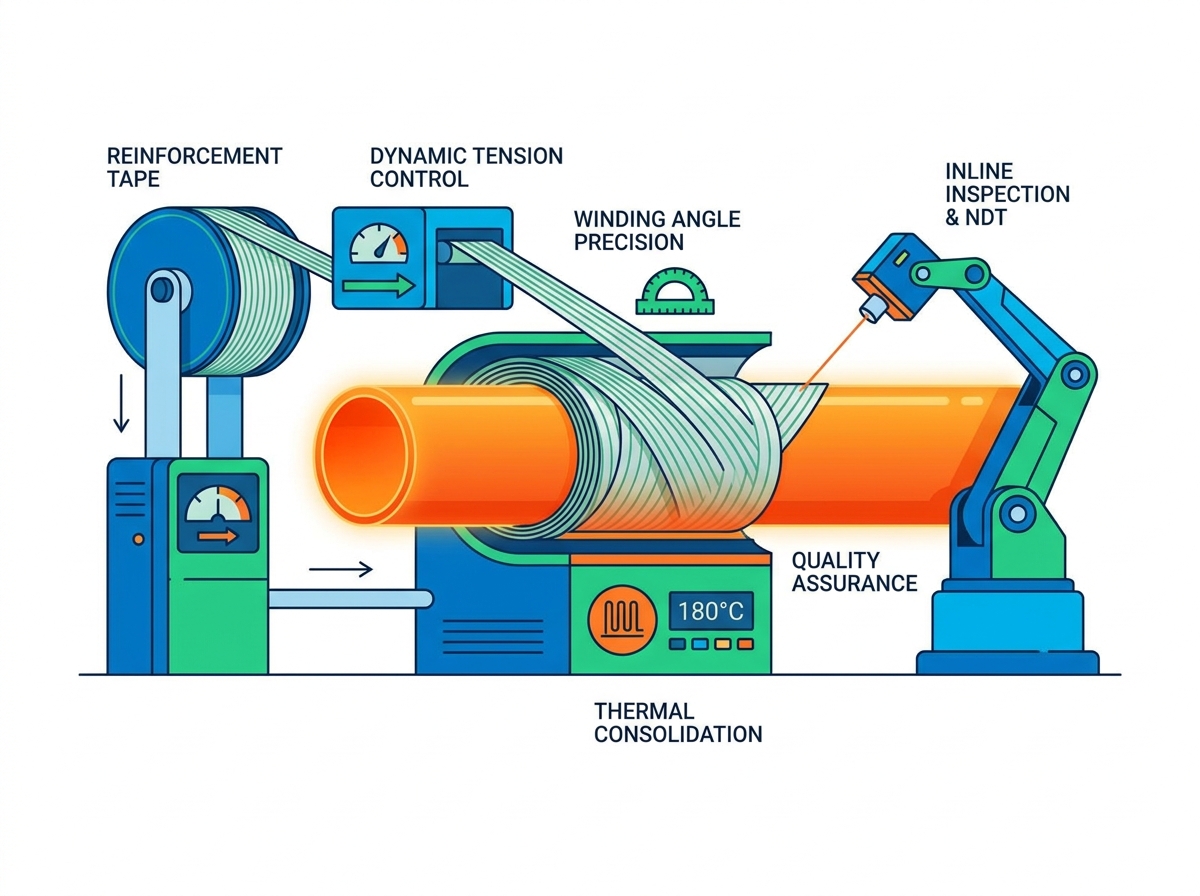
This section breaks down the complex engineering mechanics. A reputable facility must master these variables to ensure product safety. You must evaluate how suppliers manage dynamic forces and thermal energy.
Inconsistent tension creates slack or over-tightening. If the tape sits too loosely, it creates structural weakness. It cannot absorb internal pressure loads effectively. If it pulls too tightly, it crushes the thermoplastic liner beneath it. This crushing action causes fiber breakage and localized pipe deformation.
Look for manufacturers utilizing closed-loop servo-motor tension control systems. Avoid suppliers relying on outdated manual friction brakes. Closed-loop systems adjust pulling forces in milliseconds. They monitor the exact tension and compensate for spool diameter changes dynamically. As the raw material spool empties, its diameter shrinks. This shrinkage naturally alters the pulling resistance. Automated servo-motors detect this shift and adjust their torque to maintain perfectly uniform tension.
The balance between axial and hoop strength depends entirely on the winding angle. Engineers typically optimize this angle around 54.7 degrees. This specific geometry balances the outward radial forces with the lengthwise stretching forces. However, it varies slightly based on custom application demands.
Multi-layer winding requires exact synchronization. You must prevent structural asymmetry across the pipe wall. If the inner layer sits at 54 degrees and the outer layer shifts to 56 degrees, the pipe will twist under pressure. Torsional forces will eventually tear the layers apart. Advanced winding machines use synchronized gearboxes. These ensure the rotational speed matches the linear pulling speed precisely.
For thermoplastic composite pipes (TCP/RTP), fusing the layers requires precise infrared or laser heating. The matrix material must melt just enough to bond the layers together. It acts like a high-strength industrial glue.
If the temperature falls too low, you get poor adhesion. This creates a massive delamination risk in the field. If the temperature spikes too high, it causes irreversible polymer degradation. The plastic oxidizes and loses its mechanical elasticity. Sophisticated factories use optical pyrometers. They monitor surface temperatures in real time. They feed this thermal data back to a PID controller. This controller adjusts the heating laser intensity instantly.
Claims of quality mean nothing without verification on the factory floor. We must see concrete evidence of testing. A robust quality assurance program relies on both real-time monitoring and aggressive physical validation.
Modern production lines never rely solely on human eyesight. Operators use laser micrometers for real-time diameter and thickness verification. These optical sensors scan the pipe continuously as it moves down the production line. They detect microscopic variations in the outer jacket.
Factories also deploy ultrasonic or visual inspection systems. They detect surface defects, hidden voids, or improper tape overlaps on the fly. High-speed cameras photograph every inch of the winding layer before the outer jacket goes on. Algorithms analyze these images instantly. If an error occurs, the system flags the exact meter mark. Operators can then remove the defective section before it reaches the customer.
Hydrostatic burst testing validates the actual safety margins. Technicians cap a sample pipe section and fill it with water. They pressurize the water until the pipe violently explodes. They compare this ultimate burst pressure against the theoretical design limits. This test proves the pipe meets or exceeds API 15S requirements.
Peel tests verify the interlaminar shear strength. Engineers forcefully pull the bonded layers apart using a tensile testing machine. This measures the actual bond strength between the inner liner, the reinforcement tape, and the outer protective jacket. High peel strength confirms the thermal consolidation process worked perfectly.
Decision-makers need actionable criteria when evaluating potential suppliers. You cannot rely on marketing brochures alone. You must dig into their manufacturing execution systems. A rigorous audit protects your project timeline and your budget.
Use this supplier audit checklist during your next evaluation:
Traceability: Can the manufacturer trace a specific pipe batch back to the exact winding tension data? They must link every spool to its raw material batch. If a field failure occurs, you need access to the original production logs to determine the root cause.
Automation level: Does the facility rely heavily on operator judgment? The winding line should be fully automated. Look for deep SCADA (Supervisory Control and Data Acquisition) integration. Human error in setting tension brakes causes the majority of winding defects.
Compliance: Do their internal testing protocols align with third-party verifiable standards? Look for active certifications from recognized industry bodies like DNV or API. Request to see their latest audit certificates.
Take concrete next-step actions before signing a contract. Request sample failure-analysis reports from their past destructive tests. Organize a comprehensive technical site audit. Walk the factory floor to observe the NDT equipment in action. Review their sensor calibration logs to ensure their testing accuracy remains valid.
The reliability of RTP pipelines is fundamentally tied to the precision of the tape winding process. Every millimeter of tape dictates the long-term structural integrity of the final product. Even minor deviations in tension, angle, or heat can compromise the entire pressure rating.
An evidence-backed supplier doesn't just promise durability. They prove it through closed-loop tension control, rigorous thermal management, and transparent QA reporting. They invest in advanced automation to eliminate human error from the factory floor.
Encourage your procurement team to request detailed winding QA protocols. Ask for inline testing data during your next supplier evaluation. Demand visibility into their thermal consolidation logs and burst test reports. Verifying these capabilities ensures your pipeline will perform safely under the most demanding field conditions.
A: The industry standard targets 54.7 degrees. This specific angle perfectly balances internal pressure, known as hoop stress, with axial loads pulling on the pipe length. However, engineers can specify custom angles to address unique tension or pressure requirements in specialized applications.
A: They prevent delamination by relying on strict temperature control during thermal bonding. Factories use high-quality unidirectional (UD) prepreg tapes to ensure seamless matrix fusion. Automated laser or infrared heaters maintain the exact melting point without degrading the underlying polymer structures.
A: Manual controls simply cannot react fast enough to minor variations in spool diameter. This lag leads to tension inconsistencies during winding. Slack or over-tightened fibers severely compromise the pipe's maximum operating pressure (MOP). Automated servo-motors adjust pulling forces instantly, ensuring uniform load distribution.


