


Views: 0 Author: Site Editor Publish Time: 2026-10-08 Origin: Site


The energy sector is rapidly shifting from traditional steel to Reinforced Thermoplastic Pipe (RTP). This transition applies heavily to gas gathering and distribution applications. You will find this shift driven by two main factors. First, RTP offers exceptional corrosion resistance. Second, it enables incredibly fast deployment speeds in the field.
However, you must acknowledge a critical engineering reality before making the switch. Transporting compressible, volatile fluids requires much stricter qualification parameters than standard liquid service. Gas behaves differently than liquid under pressure. A failure to properly account for these dynamics can easily compromise pipeline integrity.
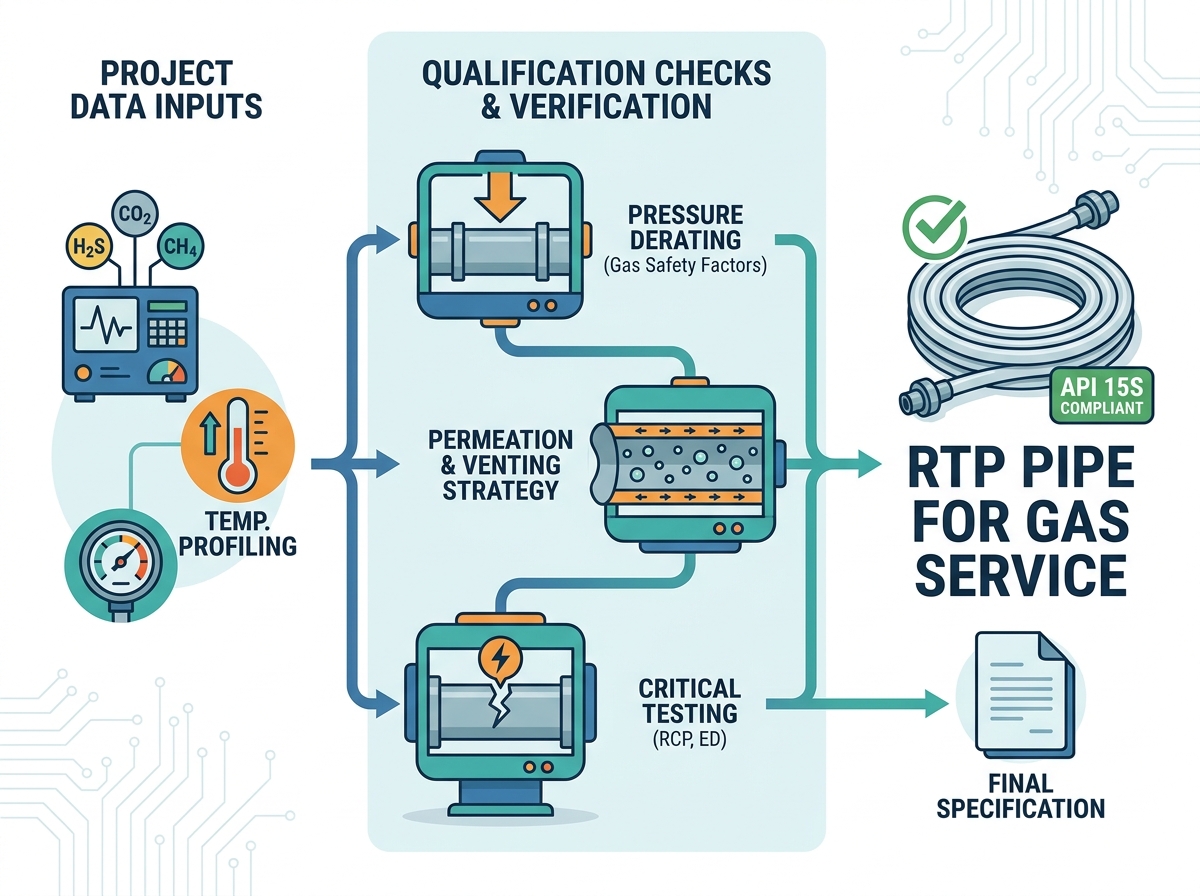
Think of this article as a technical roadmap for your engineering and procurement teams. We will guide you through defining baseline project data and verifying testing protocols. You will learn how to fully qualify an RTP pipe for gas service. We outline exactly what to review before you finalize your vendor specifications.
Data Completeness is Critical: Accurate gas composition, including aromatics, H2S, and CO2, directly dictates the polymer liner selection and reinforcement material.
Pressure Derating: An RTP pipe pressure rating is highly sensitive to operating temperatures; maximum allowable operating pressure (MAOP) must be calculated using gas-specific safety factors.
Permeation Management: Unlike steel, thermoplastics permeate gas. Proper qualification requires verifiable venting strategies and permeation rate testing.
Standardized Compliance: Shortlisting vendors requires documented evidence of API 15S compliance and rigorous Factory Acceptance Testing (FAT).
You cannot properly evaluate RTP vendors without establishing rigorous baseline project data. This data forms your primary evaluation criteria. It provides the necessary engineering inputs required before you even begin engaging manufacturers. Gathering complete information upfront prevents catastrophic specification errors.
Engineers must first identify precise concentrations of sweet and sour gas. You need exact H2S and CO2 measurements. Track your water cut carefully. Identify any heavy hydrocarbons or aromatics present in the flow. These volatile components interact directly with thermoplastic materials.
This chemical compatibility dictates your inner liner material selection. A standard High-Density Polyethylene (HDPE) liner works well for benign natural gas. However, highly sour or aromatic-rich gases require engineered alternatives. In these aggressive environments, you must specify Polyamide (PA) or Polyvinylidene Fluoride (PVDF) liners. They resist swelling and chemical degradation better than HDPE.
Thermal profiling is another mandatory step in your data collection. You must define your maximum and minimum operating temperatures. Ensure you factor in ambient soil conditions. Compressor discharge temperatures are equally important. Compressors generate significant heat, raising the gas temperature entering the pipe.
You must highlight the risk of polymer degradation at extreme temperature boundaries. High temperatures soften thermoplastic liners. This softening lowers their mechanical strength. Conversely, freezing temperatures can cause embrittlement. Embrittled polymers crack easily under sudden pressure surges or impacts. Knowing your thermal boundaries protects the pipeline's structural integrity.
Next, establish your exact installation conditions. Will you use traditional trenching, plowing, or surface laying? Each method demands different protective features. Soil mechanics also play a crucial role here.
Rocky soils require robust external impact resistance. If you choose surface laying, UV protection becomes your primary concern. The outer jacket must withstand prolonged sun exposure without degrading. Providing geotechnical inputs helps vendors specify the correct outer protective jacket for your environment.
Transporting compressible fluids introduces unique pressure handling challenges. Gas stores enormous amounts of potential energy when compressed. A rupture in a gas line is far more violent than a liquid line rupture. Therefore, technical evaluation of pressure handling is absolutely non-negotiable.
Baseline pressure ratings do not simply come from short-term burst tests. They are derived from Long-Term Hydrostatic Strength (LTHS) testing. Manufacturers subject the pipe samples to various pressures over extended periods. They plot this data to predict when the pipe will eventually fail.
Engineers then extrapolate this data. They typically create 20-year or 50-year design life projections. These projections form the foundation of your baseline rating. You must demand clear documentation showing how the manufacturer derived their LTHS curves.
Baseline ratings assume a standard ambient temperature. However, you must derate your baseline RTP pipe pressure rating as operating temperatures rise. Hotter polymers yield under lower pressures. If your gas runs at 140°F (60°C), the allowable pressure drops significantly compared to 68°F (20°C).
Furthermore, safety factor requirements differ drastically between fluid types. Compressible gas service requires much larger safety buffers than non-compressible liquid service. This difference accounts for the explosive expansion of gas during a failure.
Application Type | Fluid Characteristics | Typical Design Safety Factor | Primary Risk Factor |
|---|---|---|---|
Water / Brine | Non-compressible | 1.5 to 2.0 | Local pooling, low energy release |
Crude Oil | Mostly non-compressible | 2.0 to 2.5 | Environmental spill impact |
Natural Gas | Highly compressible | 3.0 to 4.0 | High energy release, rapid crack propagation |
You must also evaluate how the pipeline handles pressure cycling. Compressor operations frequently cause pressure to spike and dip. These cycles introduce fatigue stress into the reinforcement layers of the pipe.
A surge analysis is mandatory during the specification phase. You need to know the maximum amplitude and frequency of these pressure waves. Ensure your chosen vendor has fatigue testing data. The pipe must withstand millions of micro-cycles over its intended 20-year lifespan.
Evidence-based qualification protects your infrastructure. You cannot rely on marketing brochures. You must demand rigorous testing data emphasizing safety and E-E-A-T (Experience, Expertise, Authoritativeness, and Trustworthiness) principles. Testing separates reliable manufacturers from risky ones.
Rapid Crack Propagation (RCP) is a highly critical failure mode in gas pipelines. When gas expands during a localized breach, it freezes the surrounding polymer. This localized freezing makes the pipe brittle. The internal gas pressure then drives a crack down the length of the pipeline at supersonic speeds.
Manufacturers must physically prove their pipe resists crack transmission under pressure. They test this by initiating a crack in a pressurized sample. The pipe design must arrest the crack immediately. If the crack travels, the design fails. You must ask for verified RCP test reports.
Acknowledge the Physical Reality: All thermoplastics permeate gas. Methane molecules slowly migrate through the solid polymer inner liner.
Track the Gas Path: This permeated gas collects in the annular space. It gets trapped between the inner liner and the outer jacket.
Vent Safely: If you do not vent this trapped gas, pressure builds. It can eventually collapse the inner liner or burst the outer jacket.
Because of this, RTP gas transportation testing is mandatory. This testing quantifies precise permeation rates at specific temperatures and pressures. Engineers use this data to validate the performance of end-fitting venting systems. You need assurance that the vents can handle the predicted gas volume.
Pipelines occasionally experience sudden depressurization events. An emergency shutdown or a downstream rupture drops internal pressure to zero almost instantly. This creates a severe hazard called Explosive Decompression.
Gas that previously permeated into the polymer matrix suddenly expands. If the polymer cannot release this gas quickly enough, it forms internal blisters. These blisters destroy the structural integrity of the liner. You must define testing parameters to ensure the inner liner resists ED. The manufacturer must simulate rapid blowdowns to prove their liner does not collapse or blister.
Moving from design to implementation brings new risks. Quality assurance during manufacturing ensures the product matches the approved design. Factory Acceptance Testing (FAT) acts as your final gatekeeper prior to field deployment.
Vendors rarely test just raw pipe. They must perform spool-level hydrostatic testing. This standard procedure involves pressure-testing completed spools with the actual end fittings attached. They do this before site delivery.
This test confirms the integrity of the pipe and the connector simultaneously. The manufacturer pressurizes the spool with water to a level exceeding the maximum operating pressure. They hold this pressure for a specified duration. You should review the pressure charts to confirm zero pressure drop occurred.
A strong FAT program requires absolute material traceability. You need verifiable documentation on all raw material batches. If a field failure occurs, you must be able to trace it back to a specific resin lot.
Require dimensional reports as well. The manufacturer must prove layer thickness consistency across the entire spool. Reinforcement tensioning must remain uniform. If the glass or aramid fibers are wrapped unevenly, the pipe will exhibit weak points. Quality assurance records should capture these metrics in real time during extrusion.
The pipe itself rarely fails; the connections pose the highest risk. Your vendor qualification must highlight the evaluation of swaged or crimped connections. These fittings must provide a permanent, gas-tight seal.
Inspectors must verify proper integration of the venting mechanism within the fitting. If the vent ports are blocked or improperly machined, permeated gas cannot escape. Visual inspections and pressure retention tests on these fittings are non-negotiable components of a thorough FAT.
Finalizing the decision stage requires moving logically toward procurement. You must balance installation benefits against long-term operational advantages. Your final shortlist should only include vendors who meet strict industry criteria.
Compare the installation processes of RTP against traditional steel. Steel pipelines require extensive welding. Welders are highly specialized and hard to schedule. Every weld requires time-consuming Non-Destructive Testing (NDT) like X-rays. Steel also demands heavy lifting equipment to maneuver heavy joints.
RTP eliminates these hurdles. It arrives on large spools, allowing you to unspool thousands of feet per day. You use mechanical fittings instead of welds. This drastically reduces the need for heavy lifting and specialized NDT crews. Your project timeline shrinks from months to weeks. This efficiency is a massive driver for procurement teams.
Beyond installation, RTP completely changes your ongoing maintenance strategy. Steel pipelines constantly battle corrosion. Operators must install complex cathodic protection systems. They also pump expensive chemical corrosion inhibitors into the gas stream daily.
Because RTP utilizes inert polymers and non-metallic reinforcements, it cannot rust. You completely eliminate the need for cathodic protection grids. You no longer need to monitor sacrificial anodes or manage chemical inhibitor logistics. This structural immunity to galvanic corrosion guarantees a smoother operational lifespan.
You need a definitive checklist to narrow down your vendor options. Do not accept verbal assurances. Require hard documentation for every item below:
API 15S Certification: The vendor must hold active certification for spoolable reinforced plastic line pipe.
Historical Field Data: Demand case studies for similar gas compositions. If you have sour gas, ask for past sour gas installations.
Transparent FAT Documentation: The vendor must provide sample FAT reports showing hydrostatic test charts and dimensional logs.
Venting System Proof: They must explain their permeation management strategy and show design schematics for their fitting vents.
Specifying RTP for gas applications remains a high-stakes decision. Your success relies entirely on accurate upfront data and uncompromising qualification testing. Liquid service standards will not protect a gas pipeline.
Choosing the right pipeline requires you to look far beyond basic pressure ratings. You must actively manage gas permeation. You must enforce thermal derating rules. You also must understand and test for gas-specific failure modes like Rapid Crack Propagation and Explosive Decompression.
Take charge of the process early. Compile your project data comprehensively. Define your gas composition, temperatures, and soil mechanics first. Only then should you request technical proposals or pilot testing from qualified manufacturers. This data-driven approach guarantees a resilient, high-performing pipeline infrastructure.
A: While specific ratings vary by manufacturer and pipe diameter, high-pressure RTP can generally handle operating pressures up to 1,500–3,000 psi (100–200 bar). However, this rating is heavily derated based on maximum operating temperatures and gas-specific safety factors.
A: RTP gas transportation testing involves subjecting the pipe to operational pressures and temperatures in a controlled environment to measure the volume of gas that permeates the liner. This data is used to design appropriate venting systems at the end fittings.
A: No. Because the inner liner, structural reinforcement (non-metallic or fully encapsulated), and outer jacket are made of non-conductive, corrosion-resistant polymers, RTP is immune to galvanic corrosion and does not require cathodic protection.
A: Yes, provided the correct inner liner is specified. Standard HDPE may suffice for mildly sour environments, but highly aggressive sour gas typically requires engineered polymers like PA (Polyamide) or PVDF to prevent chemical degradation.


