


Views: 0 Author: Site Editor Publish Time: 2026-10-15 Origin: Site


Mining and industrial slurry operations face a constant, fundamental tension. Site managers must continually balance pipeline lifespan against massive upfront capital expenditures. Severe abrasive conditions ruthlessly test every infrastructure component. Unplanned downtime from pipe failure severely disrupts entire production lines. A sudden blowout or minor leak halts revenue generation instantly. It creates hazardous environmental spills requiring expensive remediation. Traditional materials force operators to compromise continuously. You usually trade pressure capacity for wear resistance or initial cost. Moving beyond standard high-density polyethylene or unlined steel requires a highly rigorous evaluation process. You need an evidence-based approach to assess hybrid materials accurately. This guide explores how advanced composite solutions change operational economics fundamentally. We will outline essential hydraulic evaluations, proper testing protocols, and practical installation realities. You will learn exactly when to upgrade your transport networks. We provide clear frameworks for maximizing reliability and ensuring long-term operational success.
Standard pipelines often fail prematurely in high-velocity, high-solids concentration tailings environments due to rapid internal wall degradation.
Evaluating a steel fiber reinforced polyethylene wear-resistant composite pipe requires analyzing specific gravity, particle angularity, and required operating pressures.
Procurement and engineering teams must demand standardized abrasion testing for composite pipe to validate manufacturer lifespan claims before site-wide rollout.
Total Cost of Ownership (TCO) models must account for implementation risks, including specialized joining methods and thermal expansion handling.
In heavy tailings transport, angular particles act exactly like liquid sandpaper. These abrasive solids travel at high flow velocities through complex piping geometries. High kinetic energy causes severe impingement on the pipe interior. These abrasive forces cause deep gouging and rapid surface erosion. Over time, continuous particle impacts strip away standard wall material. Eventually, this constant degradation leads to catastrophic wall failure in standard transport systems.
Operational budgets quickly drain when engineers choose strictly low-CAPEX materials. Teams often fall into a vicious, endless maintenance cycle. Maintenance crews must frequently rotate pipelines to even out localized wear patterns. Emergency patch repairs consume valuable skilled labor hours. Unplanned shutdowns halt entire processing plants, destroying daily production quotas. Frequent replacements multiply hidden labor costs exponentially. You lose money every minute the slurry pumps stop running.
We must define clear baseline metrics for any successful pipeline upgrade. You cannot simply install new pipes and hope for incremental improvement. A true upgrade requires specific, measurable reductions in annual wear rates. Operators should demand significantly extended maintenance intervals between required inspections. The new system must also maintain or improve overall flow efficiency over time. You need a solution solving both pressure containment and abrasion resistance simultaneously. A successful upgrade transforms reactive emergency repairs into predictable, scheduled maintenance events.
When designing a transport network, engineers typically choose between legacy metals and standard thermoplastics. Unlined steel provides excellent high-pressure tolerance for extreme pumping demands. Rubber-lined steel alternatives offer great resistance against fine-particle abrasion. Unfortunately, metallic solutions remain highly susceptible to aggressive internal chemical corrosion. Steel pipelines are incredibly heavy and require heavy lifting equipment. They are costly and dangerous to install in remote topographies. Furthermore, rubber linings often delaminate when large, coarse particles strike them repeatedly. Once the rubber peels away, the underlying steel erodes rapidly.
Standard thermoplastics offer a completely different set of operational compromises. High-density polyethylene delivers excellent chemical resistance and prevents galvanic corrosion entirely. It features a very low friction coefficient, enhancing fluid dynamics. Standard plastics remain highly cost-effective during initial procurement phases. Yet, standard thermoplastics possess strict structural pressure limitations. They suffer from material creep under sustained high-pressure loads. Worse, they degrade rapidly under highly abrasive, coarse-grit slurry conditions. Sharp tailings easily slice into soft polymer walls.
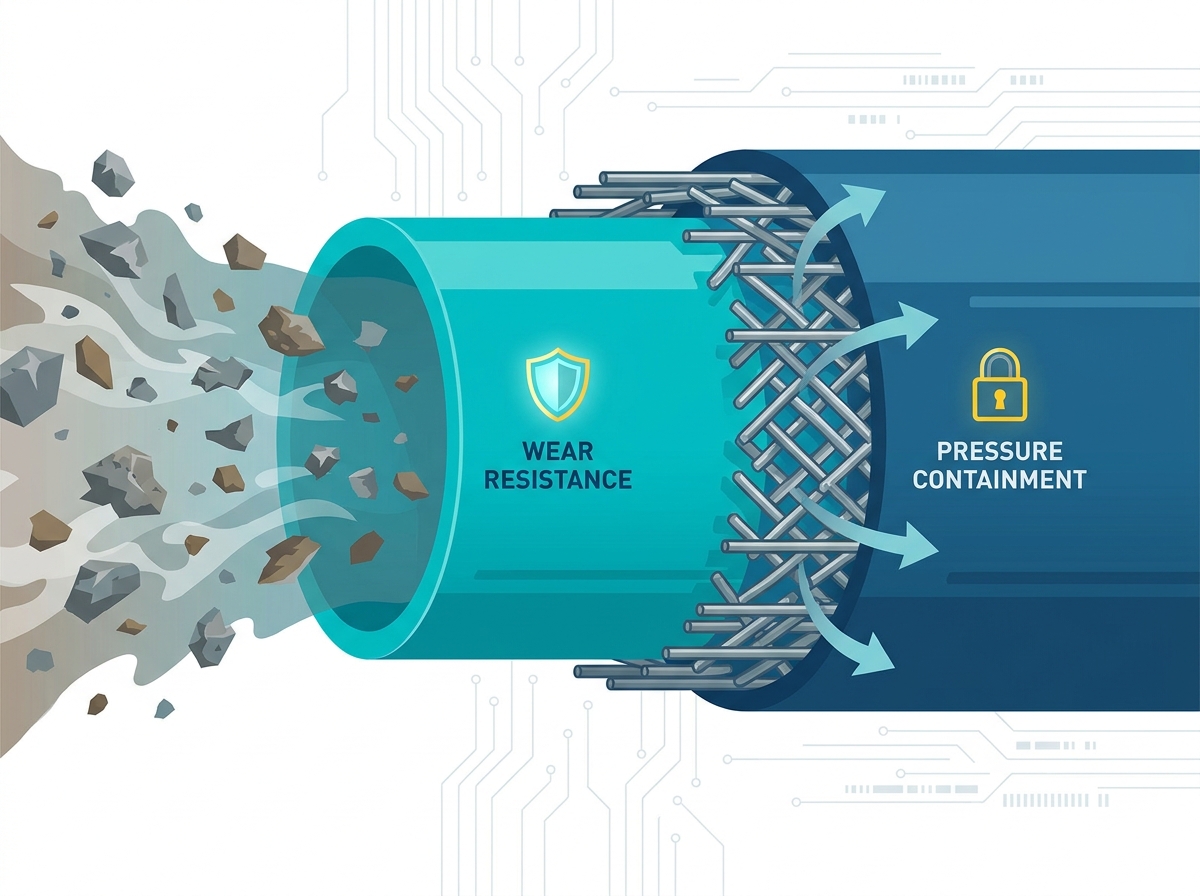
The mining industry requires a more sophisticated hybrid approach for optimal performance. We can successfully bridge this performance gap using a steel fiber reinforced polyethylene wear-resistant composite pipe. This advanced technology acts as the ultimate structural bridge. Manufacturers wind a high-strength steel fiber matrix around an inner polymer core. This wire matrix provides exceptional high-pressure containment capabilities. Meanwhile, the specialized polyethylene inner layer handles superior wear and corrosion resistance. It deflects kinetic energy from angular particles better than rigid steel. This layered design gives operators the strength of metal alongside the chemical inertness of premium plastics. You eliminate catastrophic blowout risks while extending the replacement cycle significantly.
You must match composite pipe specifications directly to your unique slurry profile. We call this systematic approach the slurry characterization matrix. Engineers must evaluate solids concentration percentages accurately before finalizing any material. Dense slurries behave differently than dilute water mixtures. Particle size distribution dictates the physical impact severity on the pipe wall. Large rocks cause impact damage, while fine sand causes scouring friction. Specific gravity determines the settling velocity of your suspended solids. Fast settling velocities require higher pump speeds to prevent pipe blockages. Higher speeds exponentially increase wall abrasion rates.
Hydraulic requirements also play a critical role in material selection. You must carefully assess pressure rating consistency under fluctuating operational loads. Slurry pumps frequently create intense pressure surges during startup and shutdown sequences. Long-distance transport demands robust structural integrity to prevent surge-induced fatigue failures. The steel fiber reinforcement mitigates these dangerous pressure spikes effectively. It prevents the plastic from expanding and bursting under heavy load.
Flow friction directly impacts your overall electrical energy consumption. Evaluating the Hazen-Williams or Darcy-Weisbach friction factors helps optimize system design. Traditional steel pipes roughen over time due to rust and scaling. The ultra-smooth composite inner wall maintains a low friction coefficient permanently. This consistent hydraulic efficiency reduces drag significantly across the entire pipeline. This efficiency allows operators to model substantial pump energy savings over decades. Lower friction means you can often downsize pump motors or reduce impeller speeds.
Pipeline Friction Factor and Performance Comparison
Pipe Material | Hazen-Williams C-Factor | Darcy-Weisbach Roughness (mm) | Flow Efficiency Rating |
|---|---|---|---|
Unlined Carbon Steel | 100 - 130 | 0.045 - 0.090 | Moderate (Degrades over time) |
Standard HDPE | 140 - 150 | 0.0015 - 0.007 | High (Subject to deep gouging) |
Steel Fiber Composite | 150 - 155 | 0.0015 - 0.005 | Excellent (Maintains smoothness) |
Decision-stage engineering requires profound skepticism and rigorous data validation. Generic marketing claims about highly durable materials are completely insufficient for major projects. Procurement teams need hard, verifiable data before approving multi-million dollar capital expenditures. You must look for rigorous standardized testing protocols in manufacturer technical sheets. Proper evaluation requires specific methodologies to ensure accuracy and repeatability. Demand results from established testing frameworks rather than internal marketing estimates.
We highly recommend reviewing data from these recognized laboratory methods:
Slurry Trough Tests for simulating continuous flow wear over time.
Sand Slurry Abrasion Tests following the strict ASTM G75 standard.
Modified Taber tests for rotational friction and surface mass loss analysis.
Translating these laboratory wear rates into realistic projections remains highly complex. A laboratory test might show a wear rate of 0.2 millimeters per year. However, laboratory sand lacks the sharp edges found in crushed mine ore. You must adjust this figure for your site-specific velocity and particle angularity. Always demand localized empirical evidence from your prospective vendors. Request regional case studies showing actual field performance in similar mines. Ask for pilot test data from parallel geological and operational environments. Third-party metallurgical and polymer analyses provide the highest level of trust. Independent verification removes vendor bias from your engineering equations.
Installing hybrid pipelines introduces unique variables to your construction project. Standard welding techniques simply do not apply to advanced reinforced polymers. Installation teams must understand specific flanging requirements clearly before mobilizing. Most systems utilize specialized mechanical couplings designed for high-pressure environments. Installers often use custom flange adapters to connect composites to existing steel pumps. Some networks require proprietary joining techniques to seal the internal steel fibers completely. If moisture reaches the reinforcing fibers, internal corrosion can compromise the structural integrity.
Environmental and topographical factors also dictate installation success in the field. Exposed above-ground lines face severe thermal expansion and contraction daily. The sun heats the dark polymer, causing it to lengthen significantly. You must engineer appropriate structural supports and thermal expansion loops. Heat cycles can easily warp improperly secured long-distance overland runs. Proper anchoring prevents the pipeline from buckling under its own thermal stress.
We strongly advise establishing Best Management Practices for maintenance immediately upon commissioning. Technicians should conduct baseline ultrasonic thickness testing right after installation. Document the exact wall thickness at designated high-wear elbows and bends. Regular inspection intervals help build highly accurate predictive maintenance schedules. Track the wear progression meticulously using a standardized grid mapping system. This proactive approach prevents sudden ruptures in aging composite networks.
Determining if your site warrants a composite pipe premium requires logical filtering. A simple decision tree helps clarify the evaluation process quickly. Ask yourself clear, binary questions about current operational pain points.
Is your standard HDPE failing before the expected eighteen-month mark?
Does your required operating pressure exceed standard thermoplastic safety limits?
Are pump energy costs inflating your monthly operational budget excessively?
If you answer yes to any question, a composite upgrade is highly viable. Next, establish strict vendor vetting criteria to narrow your options. Evaluate supplier adherence to international manufacturing standards closely. Verify their available pressure classes match your transient hydraulic models perfectly. Request comprehensive quality assurance and quality control documentation for every pipe batch. You must also assess their technical support and field engineering capabilities. Can they deploy engineers to your site during the initial installation?
Start with an actionable next step to mitigate overall rollout risk. Initiate a localized pilot program on your highest-wear pipeline section. Install a short test spool piece directly after a high-velocity pump discharge. Monitor this test section for six months using ultrasonic thickness gauges. Request a site-specific hydraulic and wear analysis from shortlisted manufacturers based on this data.
Selecting an optimal transport system requires careful risk mitigation and proactive lifecycle planning. Upgrading from legacy materials prevents catastrophic downtime and stabilizes operational budgets. The days of accepting frequent pipe blowouts as normal operating procedures are over. Transitioning to advanced composites makes sense when empirical data validates the initial investment.
Always base your procurement decisions on standardized abrasion metrics and localized pilot tests. Do not compromise on joint integrity or predictive maintenance planning during deployment. Proper installation ensures the internal reinforcement remains protected from corrosive slurries. Start evaluating your most problematic pipeline segments today. Measure the wall thickness and calculate your true maintenance burdens accurately. Consult a specialized pipeline engineer today to model your specific slurry parameters against proven composite performance data.
A: Steel fiber reinforced polyethylene offers significantly lower wear rates than standard high-density polyethylene. The specialized polymer matrix resists gouging from coarse materials much more effectively. While standard HDPE erodes quickly under high-velocity impacts, the composite inner layer absorbs and deflects kinetic energy. Actual field results vary based on specific slurry angularity and flow velocity. However, operators typically observe substantial lifespan extensions when upgrading to composite variants.
A: The main limitations involve temperature restrictions and installation complexities. The polyethylene inner layer cannot withstand extreme high-temperature processing fluids. Typical operational limits cap out around 60 to 80 degrees Celsius, depending on the specific resin grade. Additionally, joining these pipes requires specialized techniques. Installers must use precise mechanical couplings or customized flanging systems. Standard butt-fusion welding is not viable due to the internal steel fiber matrix.
A: Yes, retrofitting is entirely feasible and common in phased upgrades. You must focus heavily on securing compatible mechanical couplings and custom flange adapters. The most critical factor is exact inner diameter matching. Misaligned inner diameters create severe flow turbulence and localized wear zones. When engineered correctly, transitioning between unlined steel and composite sections provides a seamless, high-performance hybrid network.


