


Views: 0 Author: Site Editor Publish Time: 2026-07-20 Origin: Site


Procuring Reinforced Thermoplastic Pipe (RTP) or investing in RTP production lines carries high technical risk. In high-pressure oil, gas, and water applications, microscopic manufacturing defects translate directly to catastrophic field failures. Buyers face immense pressure to select vendors capable of delivering flawless, long-lasting products. Understanding the internal mechanics of an RTP facility is critical. You must distinguish between entry-level extruders and enterprise-grade manufacturing hubs.
This guide deconstructs the entire RTP manufacturing process. We highlight the exact technical tolerances you must scrutinize. You will discover the equipment capabilities and quality control frameworks necessary for success. We expose the critical factors buyers must evaluate during vendor shortlisting. Evaluating these specific metrics ensures you secure maximum reliability and safety in your field deployments.
Tension Control is the Bottleneck: The critical differentiator between standard and top-tier factories is the precision of servo-driven tension control during the reinforcement winding phase.
Bonding Integrity Determines Lifespan: Reliable facilities utilize thermal fusion rather than relying solely on adhesives to prevent layer delamination.
Inline Testing is Mandatory: Auditing an RTP pipe factory requires verifying inline, non-destructive testing (NDT) systems, not just post-production batch testing.
Compliance Drives Procurement: Shortlisting should strictly require alignment with API 15S or ISO 13628-11 standards, backed by transparent factory data.
A modern RTP factory operates continuously round the clock. It requires synchronized communication between extrusion, winding, and coating modules. Standard setups often struggle to maintain this delicate harmony. High-performance plants use advanced Programmable Logic Controllers (PLCs). They link every machine on the floor. This prevents bottlenecks and ensures continuous, smooth material flow.
You must differentiate between various solution categories when auditing facilities. Some factories produce unbonded designs. These rely purely on mechanical fit between layers. They are easier to manufacture but carry higher permeation risks. Elite facilities produce fully bonded designs. They thermally fuse the inner liner, reinforcement, and outer jacket. Fully bonded pipes resist structural fatigue far better in harsh environments.
Buyers should evaluate several core dimensions before committing to a vendor. You must assess the automation level. Determine if the factory relies on heavy manual oversight or seamless PLC integration. You should also evaluate the production line footprint and overall spooling capacity. Finally, review their energy efficiency and material waste management practices. Sustainable operations usually indicate tighter overall quality control.
Factory Architecture Comparison
Feature Category | Entry-Level Factory Setup | Enterprise-Grade Factory Setup |
|---|---|---|
Automation Level | Manual speed adjustments, isolated controls | Centralized PLC, automated SCADA tracking |
Design Capability | Unbonded (mechanical fit) | Fully bonded (thermal fusion) |
Waste Management | High scrap rates during startup/shutdown | Closed-loop recycling, optimized line starts |
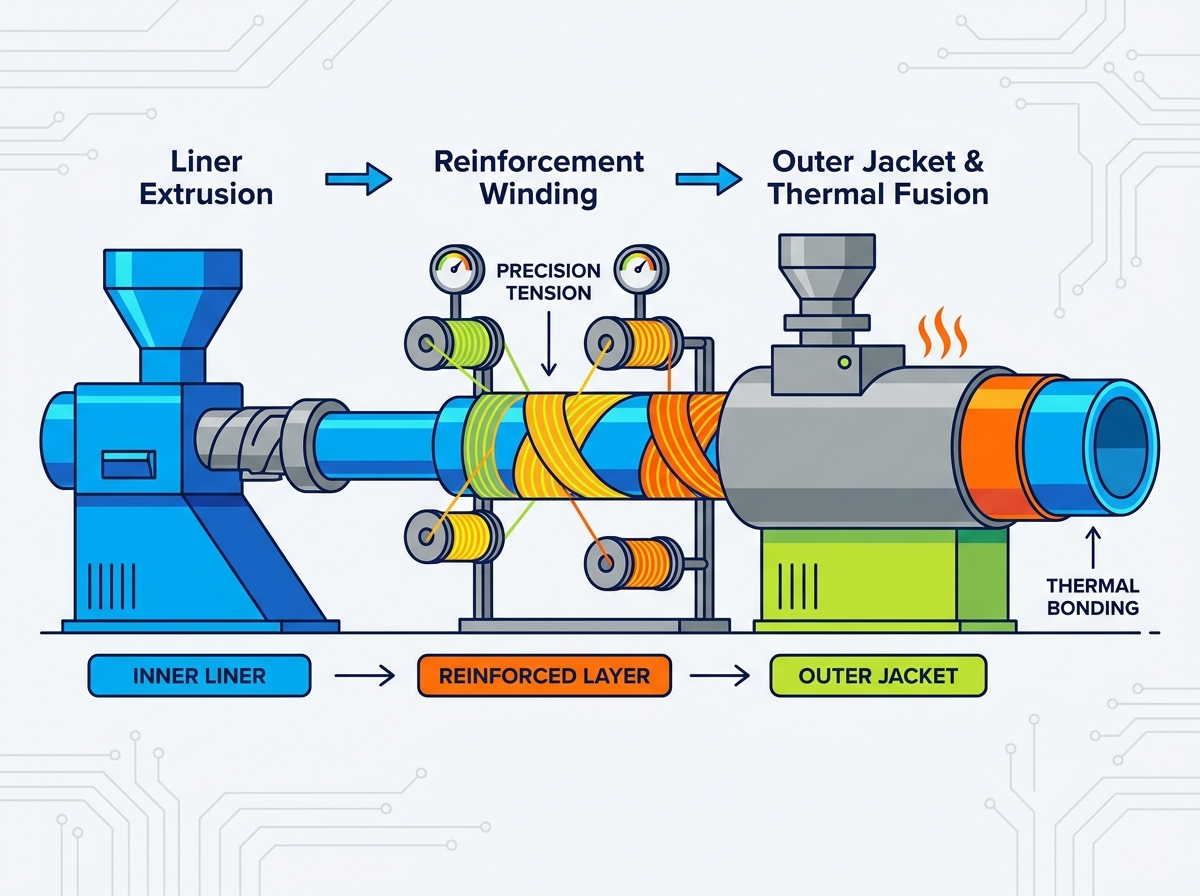
The manufacturing process begins here. The core process involves melting and forming the inner fluid-containment liner. Factories typically use High-Density Polyethylene (HDPE), Polyamide 11 (PA-11), or Polyvinylidene Fluoride (PVDF). The extruder feeds raw polymer pellets into a heated barrel. A rotating screw melts the material. The machine then forces the molten plastic through a die to form the base pipe.
Implementation realities carry significant risks at this stage. Inconsistent temperature zones in the extruder barrel lead to micro-voids. These microscopic bubbles increase gas permeation rates in the field. Another major risk involves gravimetric dosing failures. If the dosing unit fails to feed material evenly, it causes uneven wall thickness. Uneven walls create immediate structural vulnerabilities.
You must evaluate specific equipment features to mitigate these risks. Look for facilities utilizing multi-layer co-extrusion capabilities. This proves their technical maturity. More importantly, demand inline ultrasonic thickness monitoring. This technology scans the pipe 360 degrees in real time. It ensures absolute concentricity before the pipe moves to the winding station.
Best Practice: Always request the historical ultrasonic thickness logs from previous production runs. Consistent wall thickness indicates excellent temperature and dosing control.
Common Mistake: Accepting manual caliper measurements instead of continuous ultrasonic scanning. Manual checks miss localized thinning entirely.
This stage builds the pipe's pressure resistance. The core process involves wrapping the liner with high-strength materials. Manufacturers use glass fiber, aramid, or steel wire tapes. This specific phase is exactly where elite glass fiber RTP pipe manufacturers separate themselves from the rest of the market. They execute this step with flawless precision.
Uneven winding tension presents the largest implementation risk here. If one tape wraps tighter than another, it causes localized stress concentrations. When the pipe pressurizes, the tightest tape bears the entire load. It will snap prematurely. This drastically reduces the pipe's overall burst pressure rating and shortens its field lifespan.
You must evaluate the winding machinery rigorously. Verify the presence of individual servo-motor tension control for each spool. Mechanical friction brakes are insufficient for high-pressure pipes. You also need to examine the pay-off station precision and dynamic tension compensation algorithms. These algorithms adjust spool speed instantly as the roll depletes.
Finally, evaluate the tape heating methods. Top facilities use precise Infrared (IR) heaters or directed hot air. These heaters melt the polymer matrix on the tape just milliseconds before it touches the liner. This prepares the materials for a flawless molecular bond.
Verify individual servo-motor tensioners on every tape spool.
Audit dynamic tension compensation algorithms.
Inspect the placement and calibration of IR heaters.
Check clean-room conditions around the winding station to prevent dust contamination.
The third phase seals the pipe against external threats. The core process involves extruding the final UV-resistant and protective outer jacket. The machine simultaneously fuses all three layers into a monolithic structure. The liner, reinforcement, and jacket become one unified piece of engineered plastic.
Inadequate thermal management introduces severe implementation risks. If the factory fails to match temperatures perfectly, it results in weak interfacial bonding. Weak bonds lead directly to delamination during field spooling or trenchless deployment. Another risk involves cooling water bath turbulence. If the water flow fluctuates aggressively, it causes outer jacket deformation and wavy pipe surfaces.
Buyers must evaluate vacuum calibration tank stability. The vacuum tank pulls the hot outer jacket outward against a sizing sleeve. It keeps the pipe perfectly round while the plastic solidifies. You should also assess their multi-stage cooling efficiency. Rapid chilling creates residual stresses. Gradual, staged cooling yields a stronger product. Finally, demand the manufacturer’s data on peel-strength testing between layers.
Cooling Process Stage Chart
Cooling Stage | Temperature Goal | Process Objective |
|---|---|---|
Stage 1: Vacuum Calibration | Intense localized cooling | Set outer diameter, prevent sagging |
Stage 2: Warm Water Bath | Gradual temperature reduction | Relieve internal material stress |
Stage 3: Chilled Spray Tanks | Bring pipe to ambient temperature | Finalize solidification for spooling |
You cannot guarantee quality without rigorous testing. The core process involves validating the mechanical properties and dimensional accuracy of the finished pipe before spooling. Factories must prove the pipe matches the engineering specifications exactly.
Evaluation dimensions break down into two main categories. First, look at Inline NDT (Non-Destructive Testing). The line should feature continuous laser diameter measurement. It should also utilize surface defect optical scanning. High-speed cameras can catch tiny jacket scratches instantly. Second, evaluate their destructive batch testing protocols. They must verify short-term burst pressure and axial tensile strength. They must also test long-term hydrostatic strength to prove creep resistance.
Trust and evidence form the basis of a secure procurement strategy. A credible rtp pipe factory will transparently share failure-mode analysis. They will eagerly present historical batch testing data aligning with API 15S standards. They never rely purely on theoretical material spec sheets. They blow up real pipes to prove their real limits.
Best Practice: Ask to witness a hydrostatic burst test during your facility audit. Authentic manufacturers welcome this request.
Common Mistake: Accepting supplier-provided certificates without checking the date stamps against your specific batch run.
Procurement teams need a rigid decision framework to navigate the shortlisting process. You cannot rely on marketing brochures. You must base decisions on verifiable factory capabilities and historical data.
Traceability: Does the factory use automated SCADA systems? They must trace raw material batches to specific pipe spools. If a pipe fails in the field, you need to identify the exact resin batch instantly.
Tooling Flexibility: How long does it take the factory to switch between 2-inch and 6-inch pipe production? Lengthy changeovers indicate outdated machinery. Agile changeovers demonstrate advanced tooling and higher Overall Equipment Effectiveness (OEE).
Testing Laboratory: Is there an in-house, certified laboratory? They must conduct 1,000-hour survival tests locally. Sending all samples to third-party labs slows down quality feedback loops.
You must take definitive next-step actions after initial evaluations. Request a Factory Acceptance Test (FAT) protocol document upfront. Analyze a sample of their SCADA data output to verify traceability. Finally, schedule an exhaustive on-site technical audit focusing heavily on the tape winding and thermal bonding zones.
Sourcing from or investing in an RTP pipe factory requires looking well beyond maximum output speeds. Speed means nothing if the underlying structure harbors micro-defects. The true value lies in layer-to-layer bonding, tension precision, and rigorous inline validation.
Buyers must demand transparency regarding tension control tolerances and API compliance before initiating commercial negotiations. You should refuse to compromise on inline NDT systems or automated traceability. By auditing facilities against the strict technical criteria outlined above, you ensure field safety, eliminate catastrophic failures, and partner with truly capable manufacturers.
A: The reinforcement wrapping machine (tape winder). Precise tension control here dictates the pipe's pressure rating and overall structural integrity. If tension fluctuates, the pipe suffers localized stress concentrations and fails prematurely.
A: By utilizing advanced thermal fusion techniques. They use infrared heating on the tapes and precisely match the extruded jacket's temperature. This ensures the polymer matrices melt and lock together flawlessly at the molecular level.
A: Facilities should strictly adhere to API 15S for oil and gas applications, or equivalent ISO/ASTM standards. They must maintain exhaustive documentation for hydrostatic burst tests, long-term survival tests, and complete raw material traceability.
A: Depending on the factory's tooling and automation, size changeovers typically take between 4 to 12 hours. Evaluating this downtime is crucial for calculating production agility and overall equipment effectiveness.


