


Views: 0 Author: Site Editor Publish Time: 2026-07-16 Origin: Site


Procuring Reinforced Thermoplastic Pipe (RTP) for oil, gas, and high-pressure water transport carries enormous stakes. These demanding applications require flawless material integrity. A single pipe failure can trigger catastrophic environmental damage. It also invites severe regulatory penalties.
You will find countless suppliers on B2B platforms claiming to be factories. In reality, many operate strictly as trading companies. These middlemen introduce hidden markups into your supply chain. More importantly, they create dangerous quality control gaps. They rarely understand the complex composite engineering behind high-pressure pipe systems.
We built this guide to solve this exact sourcing challenge. We will provide your procurement teams with an evidence-based framework. You will learn exactly how to distinguish a genuine rtp pipe manufacturer from an opportunistic middleman. This ensures strict compliance, operational safety, and highly scalable pricing for your upcoming infrastructure projects.
Direct RTP manufacturers control the entire production and QA process, significantly reducing the risk of catastrophic pipe failures.
Authentic factories can provide immediate proof of specialized equipment (e.g., continuous winding machines, large-scale extruders) and in-house hydrostatic testing labs.
Verifying business licenses, API 15S certifications, and raw material traceability are non-negotiable steps in supplier due diligence.
Trading companies often fail technical audits and struggle to provide customized engineering data for specific operational pressures.
Sourcing directly from a factory transforms your procurement strategy. It affects material safety, technical execution, and project budgets. Middlemen simply cannot provide the necessary guarantees for high-pressure pipeline infrastructure.
RTP involves incredibly complex composite manufacturing. We bond inner High-Density Polyethylene (HDPE) layers tightly to structural reinforcements. These reinforcements usually consist of aramid fibers or high-strength steel tapes. A specialized outer jacket then protects the entire assembly. Trading companies cannot guarantee layer adhesion. They do not monitor extrusion temperatures. They cannot ensure burst pressure consistency across different batches. If a pipe bursts under 1500 psi of pressure, you hold the liability. A middleman will simply blame their unnamed sub-supplier.
Direct engineer-to-engineer dialogue remains vital for pipeline success. You need precise SDR (Standard Dimension Ratio) requirements. Different transported fluids demand specific polymer compatibilities. Sometimes you need special UV-resistant outer layers for above-ground deployment. Middlemen dilute this technical exchange. They act as a slow, inaccurate translation layer. Direct factories connect you immediately with polymer engineers. They solve complex fluid dynamics issues in real time.
Avoiding intermediary markups directly improves your project ROI. Large-scale infrastructure deployments require massive spool volumes. Even a small percentage markup from a trader inflates the overall budget substantially. Direct sourcing eliminates these unnecessary fees. You keep infrastructure budgets lean. You achieve this without ever sacrificing material integrity or safety compliance.
Supplier Impact Comparison Matrix
Factor | Direct Manufacturer | Trading Company |
|---|---|---|
Quality Control | Full internal laboratory testing per batch. | Relies blindly on sub-supplier claims. |
Customization | Can adjust winding angles and polymer grades. | Offers only standard, off-the-shelf sizes. |
Accountability | Directly liable for API 15S compliance. | Often evades warranty claims post-delivery. |
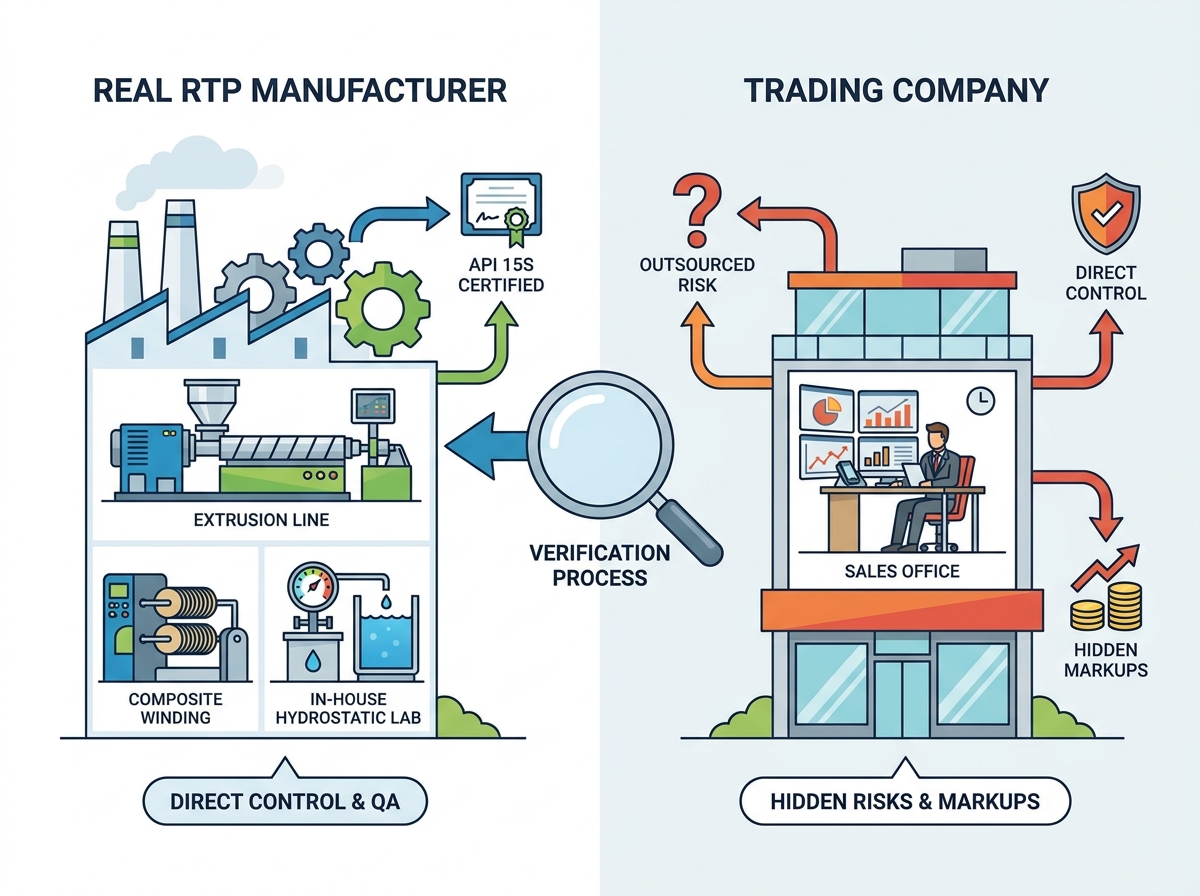
Understanding the fundamental business models of both entities helps clarify their limitations. Neither model is inherently malicious. However, they serve entirely different purposes in the global supply chain.
Trading companies excel at consolidating small, diverse orders. They effortlessly overcome cultural and language barriers. They manage complex logistics for buyers who want an assortment of different industrial goods. However, they lack true engineering authority. They do not own production equipment. They cannot alter the physical properties of the products they sell.
In contrast, leading RTP pipe manufacturers invest heavily in research and development. They own proprietary tape-winding technology. They maintain strict tension control algorithms during the manufacturing process. They employ material scientists to test polymer degradation. They hold direct, undeniable liability for international compliance standards. When you buy from them, you buy into their dedicated infrastructure.
Middlemen frequently switch their secondary factories. They do this secretly to increase their profit margins. A trader might use a high-quality factory for your sample order. They might then switch to a cheaper, unverified factory for the volume production. Buyers almost never receive a notification about this switch. This bait-and-switch tactic creates massive risks for warranty enforcement. When failures happen in the field, identifying the actual point of origin becomes nearly impossible.
You cannot rely on polished websites or enthusiastic sales pitches. You must demand hard, verifiable evidence. Use these five proven methods to filter out disguised trading companies.
Always check the registered business scope on official government portals. For Chinese suppliers, use the National Enterprise Credit Information Publicity System (NECIPS). Translate the business scope section carefully. You want to see specific words like "manufacturing," "extrusion," and "production." If the license only lists "sales," "wholesale," or "export," you are definitely dealing with a trader. Also, look at the registered capital. Real composite pipe factories require massive capital investments for heavy machinery.
Do not accept pre-recorded promotional videos. Specify exactly what you want to see. Ask for a live video call via Zoom or WeChat. Make these specific demands during the call:
Ask them to walk directly to the RTP extrusion lines.
Request close-up footage of the composite winding stations.
Ask them to show the real-time tension controllers.
Demand to see the warehouse inventory of raw HDPE and aramid/steel reinforcement materials.
Ask the representative to hold up a piece of paper with today's date in front of the machinery.
A real facility has a dedicated, fully equipped laboratory. They conduct hydrostatic burst testing daily. They verify the tensile strength of steel tapes. They perform rigorous thermal aging tests on outer jackets. Ask them to show the physical testing rigs on a video call. Request recent, timestamped test reports. If a supplier says they "outsource all testing," they do not own the factory.
High-pressure pipe applications demand strict adherence to global standards. The API 15S certification is critical for spoolable reinforced plastic line pipe. You also want to see ISO 9001 and ISO 14001 marks. Instruct your buyers to verify the certificate numbers directly. Go to the official portals of issuing bodies like SGS, TUV, or API. Ensure the company name on the certificate matches the supplier you are paying.
Genuine factories stay highly specialized. Their product catalogs look narrow and focused. They sell RTP, standard PE pipes, and compatible electrofusion fittings. A catalog offering pipes alongside unrelated industrial goods acts as a massive red flag. If a supplier sells RTP pipes, work gloves, and LED lighting, they are a trading company.
Traders know that international buyers prefer direct factories. Therefore, they have developed sophisticated tactics to disguise their true nature. You must recognize these defense mechanisms immediately.
Traders frequently claim they "own shares in the factory." They use this excuse to explain why the factory name differs from their company name. Do not accept this verbal claim. Demand legal proof of subsidiary status. Ask to see the shareholder registry. If they cannot produce legal documentation proving common ownership, they simply buy from that factory like any other customer.
Fake factories resist independent oversight fiercely. They will push back against unannounced site visits. They will invent excuses about "confidentiality" or "trade secrets" to block independent technical audits. A genuine facility welcomes third-party inspectors. They view audits as a chance to prove their operational excellence.
Look closely at the registered office address on their documentation. Does it point to a downtown commercial high-rise in a major financial district? Heavy extrusion machinery does not fit in office buildings. True manufacturing hubs sit inside dedicated industrial zones, often on the outskirts of cities. While some large factories maintain separate sales offices, they will gladly share the actual factory address upon request.
Common Disguise Tactics Chart
Disguise Tactic | What They Say | How to Uncover the Truth |
|---|---|---|
Name Mismatch | "We are the export branch of the factory." | Demand a joint ownership certificate or financial link. |
Address Hiding | "The factory is in a restricted zone." | Check Google Earth or Baidu Maps for industrial footprints. |
Video Refusal | "We cannot film due to client privacy." | Insist on viewing generic machinery without client logos. |
Once you filter out the obvious traders, you must evaluate the remaining candidates. Use this three-step procurement framework to finalize your supplier selection.
Structure your Request for Quotation (RFQ) specifically to weed out unqualified suppliers. Ask highly technical questions. Request specific polymer grade data (e.g., Melt Flow Index). Ask for the yield strength of the steel tape reinforcement. Demand detailed failure mode analysis data from their past projects. Traders will struggle to answer these. They will give vague answers or take days to reply because they must forward the questions to the actual factory.
Never commit to a volume order based purely on a specification sheet. Advise your team to order short lengths first. Send these samples directly to an independent laboratory. Conduct your own burst and delamination testing. Cut the pipe open. Inspect the bonding between the inner liner and the reinforcement layer. Only proceed to volume orders when the independent tests validate the supplier's claims.
For major infrastructure contracts, remote verification is not enough. Recommend hiring local, specialized third-party engineering inspectors. Have them conduct a comprehensive site audit. Do this exactly during a pilot production run of your order. They should verify the raw material lot numbers. They must watch the extrusion process. This physical presence guarantees the factory uses the exact materials you specified.
The catastrophic costs of a pipeline failure far outweigh the upfront effort of strict supplier verification. Taking shortcuts during the procurement phase invites unacceptable risks. You must protect your infrastructure by rooting out middlemen early in the sourcing process.
Always demand total transparency from your partners. Ask for physical proof of manufacturing capability. Require direct access to their polymer engineers. Genuine facilities will gladly accommodate these requests to build long-term trust.
Take action today to secure your supply chain. Review our facility's comprehensive technical specifications online. Request a live virtual factory tour to see our winding machines in action. Alternatively, consult directly with our engineering team to discuss your specific pressure requirements.
A: They can sell them, but the certificate will be in the actual factory's name. If they refuse to show the original factory certificate, their compliance is completely unverifiable. You run the risk of receiving uncertified pipes.
A: A real facility requires core polymer extruders, specialized wrapping and winding machines for steel or aramid tape, and dedicated high-pressure hydrostatic testing rigs. They also need large-scale spooling equipment for the finished product.
A: Locate the "Business Scope" section on their NECIPS registration. Use a translation tool to look for specific manufacturing keywords like "production," "extrusion," or "manufacturing." Avoid suppliers whose scope only lists "wholesale," "retail," or "technology consulting."


