


Views: 0 Author: Site Editor Publish Time: 2026-10-30 Origin: Site


Choosing the wrong hydraulic hose creates massive operational headaches. You risk immediate system downtime. You might face severe pump cavitation or hazardous fluid leaks. Heavy environmental compliance fines often follow these preventable failures.
Hydraulic systems demand precise component matching. You must pair the hose construction directly to the specific line function. Vacuum or suction lines need fundamentally different structural integrity. They behave differently than high-pressure discharge lines. You cannot treat them as interchangeable parts.
This article provides a definitive decision framework. We will explore how to specify the exact hydraulic hose you need. You will learn to evaluate pressure dynamics, flow requirements, and environmental variables. By the end, you will know exactly when to rely on suction, delivery, or combined hoses.
Delivery vs. Suction: A standard hydraulic oil delivery hose is designed solely for positive pressure; using it in a suction application risks internal collapse and catastrophic pump failure.
Combined Versatility: A hydraulic oil suction and discharge hose integrates a helical wire to handle both vacuum (negative pressure) and high discharge pressures, ideal for dynamic or dual-purpose lines.
Standardization is Critical: Hose selection must strictly follow system requirements and international standards (SAE, EN, DIN) using a structured evaluation method (like the STAMP framework).
Material Compatibility: The inner tube must be chemically compatible with the specific hydraulic fluid (e.g., petroleum-based, water-glycol, or synthetic) to prevent degradation.
Understanding internal construction helps you prevent catastrophic line failures. Manufacturers engineer each hose category to combat specific physical forces.
This type transports fluid from the pump directly to system components. It operates strictly under positive pressure. The structural design relies on high-tensile steel wire braids or spirals. You will not find a helical wire coil inside this hose.
The braided construction resists extreme internal expansion. It prevents the rubber tube from bursting under heavy loads. A standard hydraulic oil delivery hose remains ideal for high-pressure hydraulic circuits. You should use it for actuators and discharge lines where vacuum forces remain at zero. It offers excellent flexibility and keeps overall machine weight down.
Suction hoses pull fluid from the reservoir to the pump. This creates negative pressure, also known as vacuum. Standard hoses flatten easily under these conditions.
Engineers build suction hoses using a continuous helical wire reinforcement. This rigid coil prevents the hose from collapsing inward. The structure easily handles suction forces. These hoses perform perfectly for pump inlets. They also work well for low-pressure return lines requiring tight bend radii. The helical wire ensures the tube stays open, preventing kinking during tight routing.
Some applications demand a dual-purpose solution. A hydraulic oil suction and discharge hose handles both vacuum draw and positive pressure discharge. It serves as a highly versatile component in complex fluid systems.
The construction features both heavy-duty wire braiding and a helical wire structure. You gain the burst resistance of a delivery line. You also get the anti-collapse strength of a suction line. Trade-offs do exist. These combined hoses weigh more. They offer less flexibility. However, they drastically reduce inventory complexity for systems experiencing fluctuating pressure states.
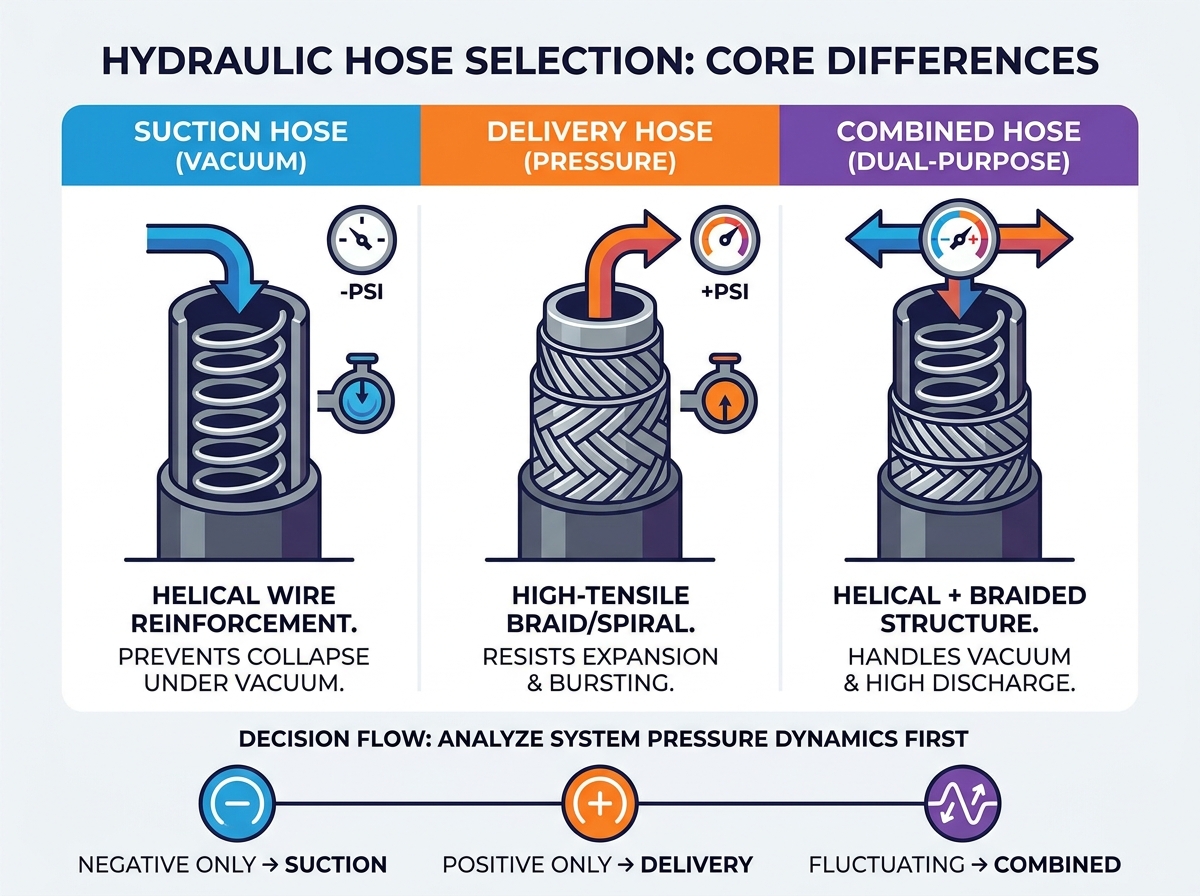
Selecting the ideal hose requires matching structural capability to your actual operating environment. You must analyze the fluid direction and ambient conditions closely.
Choose delivery hoses when your system operates strictly under positive pressure. These environments never experience vacuum draw. Mobile equipment and articulating arms serve as perfect examples. These machines require maximum flexibility. They also benefit significantly from minimum weight. The absence of a rigid helical wire makes installation much easier in confined engine compartments.
Specify suction hoses for dedicated reservoir-to-pump lines. You need these hoses for low-pressure fluid transfer. In these scenarios, preventing pump cavitation stands as your primary success criterion. The helical coil guarantees smooth fluid entry into the pump housing. You avoid starving the system, keeping machinery running efficiently.
Combined hoses thrive in dynamic environments. You should specify them for tank truck fluid transfer and off-loading operations. They handle systems where flow direction reverses regularly. High-vibration environments also benefit from this design. The structural rigidity prevents line flattening when heavy machinery shakes during operation.
Hydraulic Hose Application Comparison
Hose Category |
Primary Pressure State |
Key Reinforcement |
Flexibility Level |
Best Use Case |
|---|---|---|---|---|
Delivery Hose |
Positive Pressure Only |
Braided/Spiral Wire |
High |
Actuators, High-Pressure Lines |
Suction Hose |
Negative Pressure (Vacuum) |
Helical Wire |
Medium |
Reservoir to Pump Intakes |
Combined Hose |
Both Positive & Negative |
Braid + Helical Wire |
Low (Rigid) |
Reversing Flows, Tank Off-loading |
Technical evaluation prevents catastrophic failures. You must rely on objective data rather than guesswork during the specification process.
Always evaluate the Maximum Working Pressure (MWP). Compare this figure against your system relief valve settings. Ensure the hose burst pressure meets the industry-standard 4:1 safety factor. This means a hose rated for 1,000 PSI working pressure must withstand 4,000 PSI before bursting. For suction lines, you must verify absolute vacuum ratings. Engineers typically measure this in inches of mercury (in-Hg). Ensure the hose handles the maximum vacuum your pump can generate.
You must assess fluid temperature ranges accurately. Extreme heat degrades rubber compounds rapidly. Hardened rubber loses its flexibility and reduces burst strength. Cold environments pose equal risks, causing brittle inner tubes. Note that combined heat and continuous pressure accelerates hose fatigue. Always check the dual temperature ratings for both the ambient environment and the internal media.
Mismatching the inner tube material to the fluid destroys the hose from the inside. Identify whether your system uses petroleum-based oils, water-glycol, or synthetic fluids. Nitrile (NBR) inner tubes offer excellent resistance to standard petroleum-based oils. However, specific biodegradable or synthetic fluids might require Neoprene or specialty elastomers. Always consult chemical compatibility charts.
Never install uncertified hoses. Validate your choices against SAE J517 standards. For instance, SAE 100R4 specifically covers wire-inserted hydraulic suction hoses. European standards (EN) and German standards (DIN) provide similar stringent benchmarks. Using compliant hoses ensures authoritative performance. It also provides vital liability protection for your engineering team.
Ignoring operational parameters leads directly to system destruction. Real-world failures happen quickly and carry severe consequences.
Using a standard delivery hose on a suction line guarantees trouble. The inner tube collapses inward under the vacuum force. This pinches off the fluid supply, starving the pump of oil. The pump begins drawing in air vapor, inducing cavitation. You will hear a distinct, loud whining noise. Cavitation literally tears chunks of metal away, destroying the pump hardware in minutes.
Specifying a suction-only hose for high-pressure delivery ends violently. Suction hoses lack the heavy wire braiding needed to contain extreme outward forces. Pushing thousands of PSI through them leads to immediate catastrophic rupture. The hose will burst open or blow off its fittings. This sends dangerous, high-velocity hot oil spraying across the work area.
Combined hoses possess a larger Minimum Bend Radius (MBR) due to their bulky construction. Forcing them into tight spaces bends them past their structural limit. This causes kinking on the inside curve. It also creates extreme wire fatigue on the outside curve. Premature failure becomes inevitable.
Best Practice: Never bend a hose beyond its MBR. Instead, utilize proper angled fittings. Install 45° or 90° elbows to navigate tight corners. This relieves physical stress on the hose assembly and extends its operational life significantly.
Industry professionals rely on a proven methodology to avoid errors. Following a structured rubber hose selection checklist ensures you cover every critical engineering parameter before placing an order.
Size (S): Calculate the exact Inner Diameter (I.D.). Use an industry nomograph to ensure optimal fluid velocity. Proper sizing minimizes internal turbulence. It also prevents excessive heat generation inside the system.
Temperature (T): Document the minimum and maximum temperatures. You must account for both the external environment and the internal fluid. Temperature spikes dictate the type of rubber compound you need.
Application (A): Define the operational environment clearly. Consider external threats like severe UV exposure or heavy abrasion risk. Note if the hose will undergo constant dynamic flexing or remain stationary.
Material (M): Confirm chemical compatibility. The inner tube must handle the specific hydraulic fluid. The outer cover must resist external contaminants like ozone, saltwater, or industrial chemicals.
Pressure (P): Document the required system working pressure. You must also account for sudden pressure spikes, known as surges. For suction lines, map out the exact vacuum requirements.
Ends (E): Identify the necessary coupling types. Match the thread configurations to your existing hardware. Determine the correct orientation for angled fittings to ensure stress-free routing.
Delivery (D): Outline your specific volume and velocity requirements. Note any testing or certification documentation needed prior to installation. Ensure suppliers can meet your maintenance schedules.
Selecting the correct hydraulic hose requires strict adherence to system pressure profiles. You must never substitute a delivery hose for a suction application. Doing so invites pump failure, safety hazards, and massive mechanical damage. Each hose category serves a highly specific physical purpose in your hydraulic circuit.
Evaluate your system comprehensively before making a final choice. Look closely at your vacuum needs and potential pressure spikes. Analyze your physical routing constraints. This shortlisting logic prevents costly mismatches and ensures maximum uptime for your machinery.
Take action today to secure your fluid systems. Consult with a certified hydraulic specialist or trusted manufacturer. Audit your current fluid conveyance lines. Match every single assembly with proper SAE or EN-compliant components to guarantee long-term reliability.
A: No. Delivery hoses lack the helical wire reinforcement needed to withstand negative pressure. If you apply a vacuum, they will collapse inward immediately. This blocks fluid flow, causing severe pump cavitation and catastrophic mechanical damage.
A: Typically, it is 4:1. The burst pressure should be at least four times the maximum working pressure. Though standards vary slightly by specific SAE or EN classifications, this ratio ensures the hose can survive unexpected pressure surges.
A: Combined hoses are much stiffer due to dual reinforcements, including braid and helix. If your equipment requires tight routing, a dedicated, highly flexible hose with appropriate angled fittings is usually safer. Forcing a stiff combined hose into tight bends causes kinking and premature failure.


