


Views: 0 Author: Site Editor Publish Time: 2026-10-23 Origin: Site


Selecting the wrong blast hose leads to premature wear, unpredictable pressure drops, and severe workplace safety hazards. Industrial abrasive blasting environments are incredibly punishing. Using a subpar or mismatched hose invites operational nightmares. These range from dangerous blowout incidents to hidden frictional pressure losses. Engineers and procurement managers need a strictly evidence-based framework. You must evaluate and specify the correct hose configuration. You must carefully balance media type, airflow requirements, and rugged site conditions to ensure smooth operations. Balancing upfront component costs against the hidden risks of operational downtime and catastrophic system failure is critical. In this guide, you will learn how to properly match hose bore sizes to airflow. We will break down structural integrity requirements, exact coupling selection, and daily wear prevention tactics. This keeps your crews safe and your project on track.
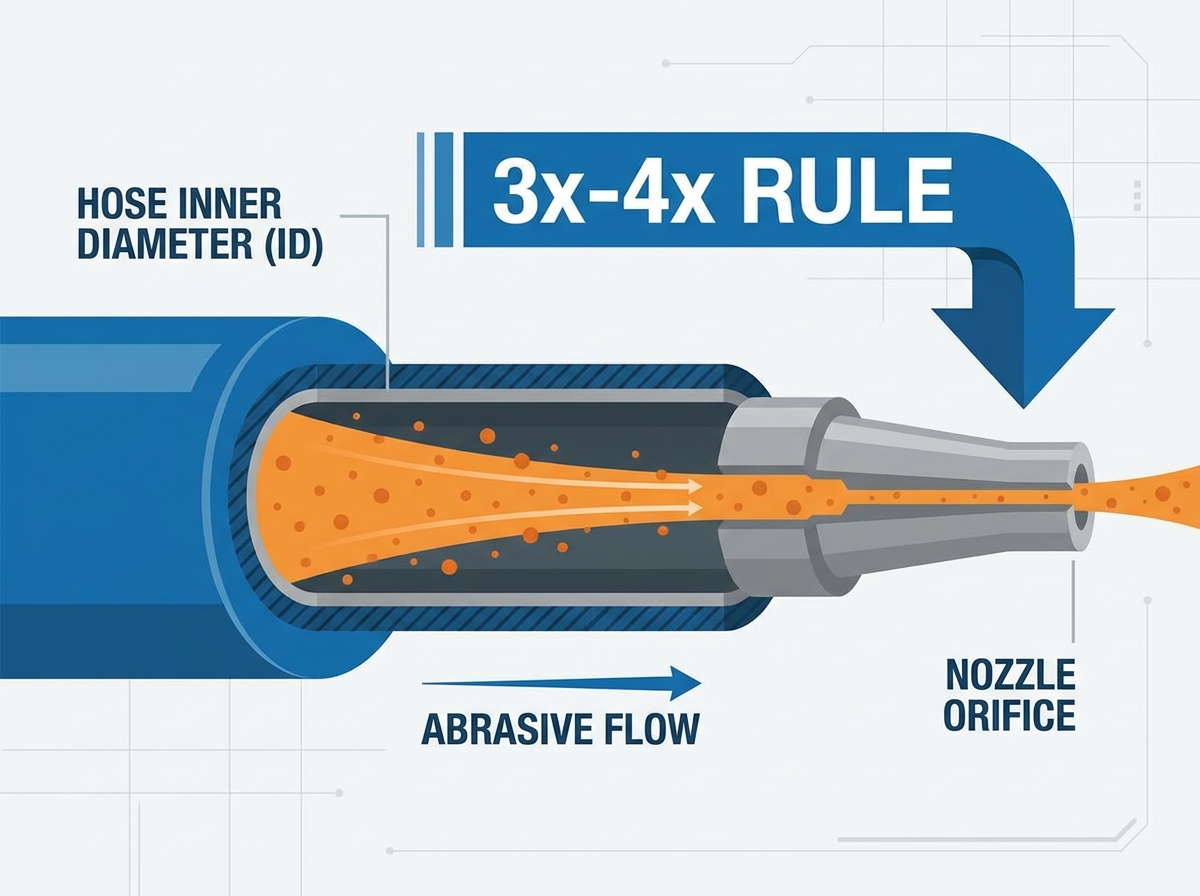
Optimal Sizing: Hose inner diameter (ID) must be three to four times larger than the nozzle orifice to minimize friction loss and internal wear.
Structural Requirements: A certified sand blast rubber hose requires a static-dissipating inner tube, high-tensile reinforcement, and a weather-resistant outer cover.
Coupling Integrity: Coupling material (nylon, brass, aluminum) must align with the operational environment, and mandatory safety cables (whip checks) are non-negotiable for compliance.
Wear Prevention: Most premature failures stem from external cutting (dragging across abrasive surfaces) rather than internal media friction.
Successful abrasive blasting relies on optimal equipment synergy. You must define what a successful deployment actually looks like. Success means achieving zero blowout incidents. It means scheduling highly predictable maintenance cycles. It also requires maintaining perfectly stable nozzle pressure throughout the shift. When you specify the exact correct hose, you achieve all three goals.
The cost of misalignment hits operations hard. Using an undersized hose forces the compressor to work harder. It restricts airflow and causes significant pressure drops at the nozzle. When you lose pressure, you lose blasting efficiency. Inadequate abrasion resistance accelerates your replacement cycles. Crews spend valuable time swapping out blown lines instead of working. You burn through inventory and stall production timelines.
Safety and compliance form your non-negotiable baseline. We evaluate hose specifications strictly through the lens of OSHA regulations. International industrial safety standards dictate strict rules for pressurized abrasive lines. If a hose ruptures under 150 PSI, it becomes a deadly whip. Specifying the correct burst pressure rating protects your crew. It shields your company from severe compliance penalties and liability risks.
Precision sizing dictates your blasting efficiency. The most critical metric is the 3x-4x Rule. Your hose inner diameter (ID) must be significantly larger than your blast nozzle orifice. Specifically, the ID should be three to four times larger. If you use a 1/4-inch nozzle, you need at least a 3/4-inch ID hose. If you step up to a 3/8-inch nozzle, you need a 1-1/4-inch ID hose. This ratio minimizes friction loss and slows internal media velocity.
Calculating friction loss is essential for long hose runs. Both hose length and internal diameter dictate your pressure drop over distance. Air and abrasives create intense friction against the inner tube. A narrow bore forces the air to travel faster. Higher velocity increases friction, which destroys the inner tube. It causes significant pressure drop. Every PSI lost at the nozzle reduces your cleaning speed by roughly 1.5 percent.
You must ensure full compressor CFM compatibility. Ensure the specified hose bore accommodates the compressor's volumetric output. You cannot push 375 CFM through a narrow 3/4-inch hose efficiently. It causes severe bottlenecking. It creates excessive internal velocity, leading to rapid hose degradation. Match your hose ID to the total air volume to maintain a smooth, destructive-free flow.
Evaluating a blast line means looking deeply at its anatomy. Every sand blast rubber hose features three distinct structural layers. The inner tube composition is your first line of defense. Dry abrasive media generates massive amounts of static electricity. The inner tube must feature a carbon-black blended rubber compound. This specific blend dissipates static electricity safely. Without it, operators face severe shock hazards, and combustible dust environments become explosive.
Reinforcement layers give the hose its strength. Manufacturers typically offer 2-ply and 4-ply high-tensile textile or cord configurations. The reinforcement maintains the required working pressure (WP). A 2-ply hose offers great flexibility for tight spaces. A 4-ply hose provides maximum pressure stability for heavy-duty industrial tasks. You must choose a ply count that supports your pressure needs without sacrificing required flexibility.
Outer cover durability dictates the physical lifespan on site. You need an abrasion-resistant industrial hose that survives harsh exterior conditions. Shipyards and construction sites are unforgiving. The cover protects against UV degradation and ozone cracking. It also defends against environmental dragging over sharp steel edges and concrete.
Always verify claims against objective industry standards. Look for standard abrasion loss metrics. Reliable manufacturers test their rubber compounds against DIN 53516 or ISO 4649 standards. These tests measure exactly how much rubber is lost under friction. Demand these spec sheets to verify the manufacturer claims objectively.
Even the strongest hose fails if the coupling disconnects. You must conduct a strict coupling material evaluation. Each material behaves differently under job site stresses.
Coupling Material Comparison
Material | Characteristics | Ideal Application | Limitations |
|---|---|---|---|
Nylon | Lightweight, corrosion-resistant | Standard outdoor use, mobile blasting | Susceptible to extreme temp changes or heavy impacts |
Aluminum | Good balance of weight and durability | Standard industrial choice, shipyard use | Can deform if crushed by heavy machinery |
Brass | Heavy-duty, spark-resistant | Refineries, combustible environments | Heavier weight increases operator fatigue |
Fitment and tolerances require exact matching. The exterior hose diameter (OD) must precisely match the coupling claw or receptor. Do not guess the OD. If the hose OD is too small, it causes slippage under pressure. If it is too large, the screws will crush the internal layers. A precise fit prevents catastrophic blowouts.
Compliance mechanisms are legally required safety features. You must implement safety lock pins on every connection. Furthermore, whip checks (safety cables) are absolutely mandatory. They span across the coupling joints. If a coupling disconnects under pressure, the whip check restrains the hose. This simple cable mitigates the catastrophic risk of coupling disconnection.
You need a systematic approach to narrow down your procurement options. Follow these specific steps to ensure you specify the exact product for your needs.
Step 1: Define the Application. Identify the specific job environment. Are you performing heavy shipyard descaling? Do you need precision industrial cleaning? Or is this for general construction? Each application demands different flexibility and cover toughness.
Step 2: Assess Working vs. Burst Pressure. Verify the rated Working Pressure. It typically runs between 150 and 175 PSI. It must meet your system demands. Ensure there is an adequate safety factor, known as the burst pressure ratio.
Step 3: Media Compatibility Check. Not all abrasives are equal. Ensure the rubber compound withstands the specific aggressiveness of your media. Steel grit destroys standard rubber much faster than crushed glass or walnut shells.
Step 4: Environmental Assessment. Evaluate your ambient conditions. Look for extreme temperatures or chemical exposure. These factors degrade standard rubber compounds rapidly. Specify specialized synthetic blends if you operate in extreme heat or oily environments.
Note: You should use this rubber hose selection checklist to filter vendors. Base your final decisions on verifiable spec sheets, not on vague marketing claims.
Understanding how a hose fails helps you prevent it. You must differentiate between internal wear and external cutting. Standard internal degradation is unavoidable. It happens fastest at sharp bends and near the nozzle assembly. However, external cutting is entirely preventable. Dragging hoses over sharp edges accounts for most premature failures. Stop dragging hoses over exposed rebar or sharp steel plates.
Routing best practices significantly extend service life. How you lay out the hoses matters. You must minimize sharp bends along the route. Sharp bends force abrasive media directly into the rubber wall. This creates localized thin spots and reduces internal turbulence. Keep your lines as straight as possible. Use wide, sweeping arcs when turning corners.
Establishing routine inspection protocols prevents accidents before they happen. Schedule a physical inspection before every single shift. Operators should run their hands along the line. They must feel for soft spots indicating internal wear. They should check visually for cover gouges. Finally, they must inspect coupling gaskets for dry rot or compression damage. Catching these issues early saves money and prevents injuries.
Specifying a blast hose is a comprehensive system-level decision. You must align the compressor, abrasive media, hose structure, and nozzle perfectly.
Start your procurement process by auditing current failure points. Determine whether internal wear or external damage causes your replacements.
Use your findings to inform your next specification, ensuring you address the actual root cause of failure.
Consult with technical sales engineers early in the process. Use the established checklist to request exact product data sheets. Always demand compliance certifications to ensure safety standards.
A: Working pressure (WP) is the maximum continuous operating pressure a hose can safely handle daily. Burst pressure is the absolute failure threshold where the hose ruptures. Manufacturers build in strict safety margins, typically using a 3:1 or 4:1 ratio. A hose with a 150 PSI working pressure will have a 600 PSI burst pressure.
A: Dry abrasive media creates intense friction as it travels through the tube. This friction generates a massive static charge build-up. An electrically conductive inner tube safely dissipates this static electricity. Without it, operators risk severe electrical shock. It also prevents ignition sparks in hazardous, combustible environments.
A: Replacement timelines depend entirely on usage intensity. You should inspect them daily. Gaskets typically need replacement every few weeks in heavy-use environments. Look for compression wear or dry rot. Couplings should be replaced immediately if the safety pins fail, threads wear down, or cracks appear. Always prioritize preemptive replacement over emergency failure response.


